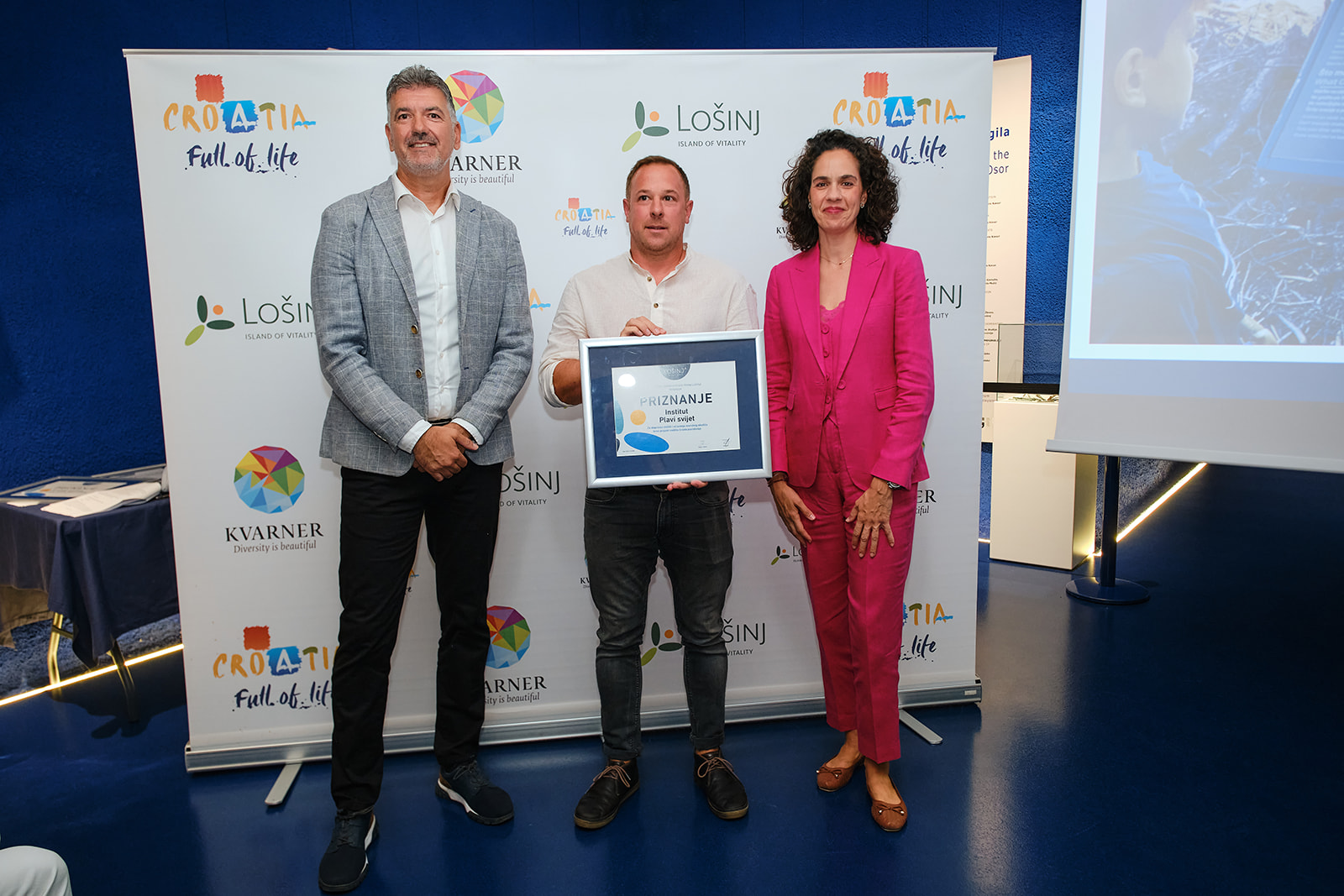
The Blue World Institute has received the “Business Excellence 2026” award in the NGO category
We are proud that the Blue World Institute has received...

14.07.2024
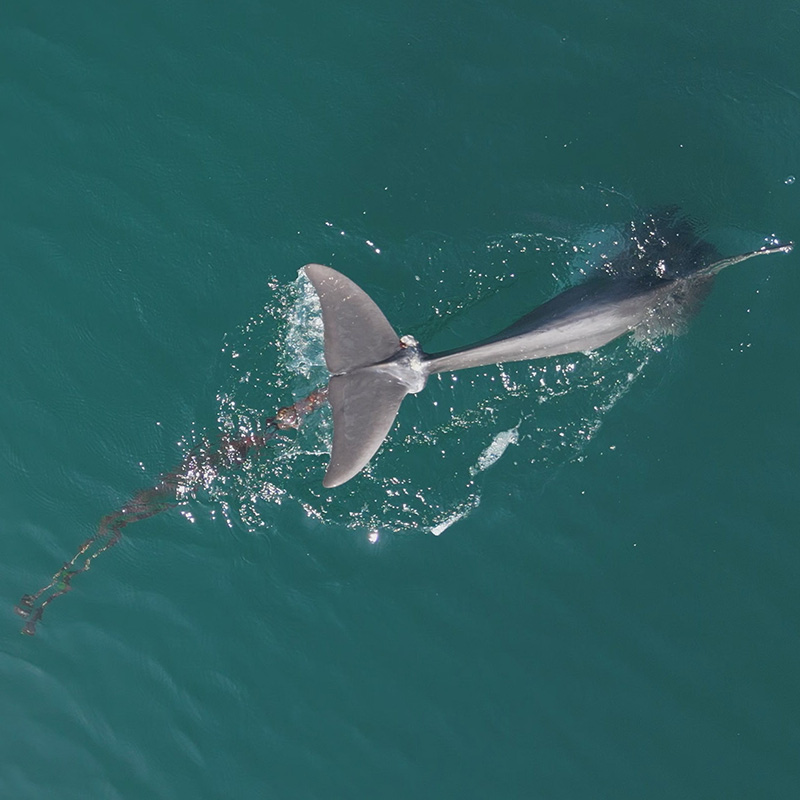
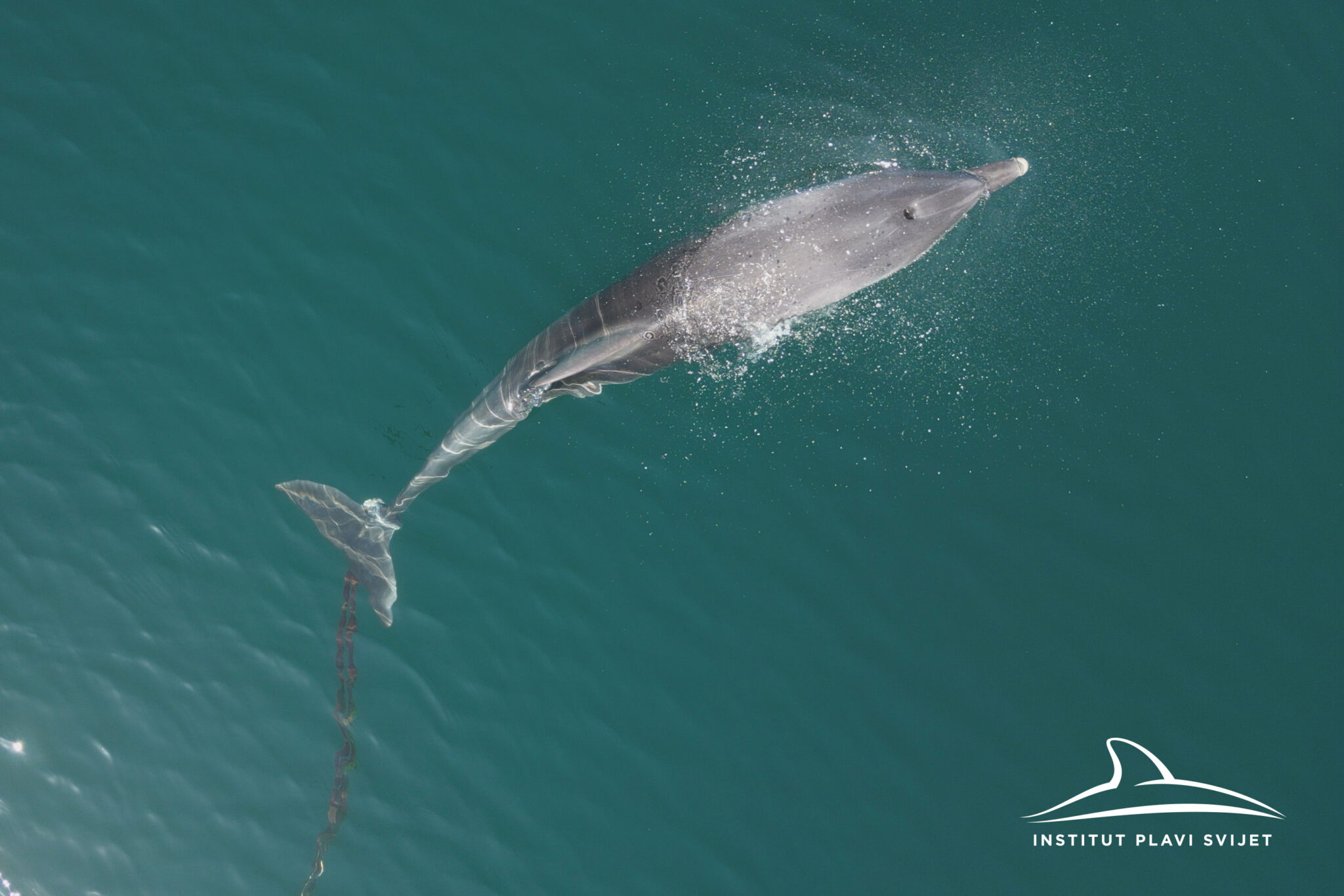
Bottlenose Dolphin in the Novigrad Sea with Rope Entangled Around Its Tail
Over the past few days, considerable media attention has been focused on a bottlenose dolphin (named Oliver) in the Novigrad Sea that has a piece of rope entangled around its tail and trailing behind it. Citizens have been reporting sightings of this dolphin to us since last autumn, and we would therefore like to inform the public that the Blue World Institute has been monitoring this individual and its condition.
In order to gather detailed information and, if possible, free the dolphin from the remaining rope in which it is entangled, researchers from the Blue World Institute conducted a field operation in the Novigrad Sea on Friday, 12 July 2024. Using two vessels and specialised equipment, we searched for the animal and, after locating it, collected numerous photographs and video recordings required for its identification and health assessment.
We established that the dolphin is the individual recorded in our catalogue under the identification code L_2191s21, first observed on 21 May 2021 together with its mother, L_2191, in the Velebit Channel. Based on these records, we estimate that the dolphin is between five and six years old.
The dolphin has a rope, slightly over one metre in length, tightly entangled around the base of its tail. We believe this is a remnant of a fishing net in which the animal became entangled, with part of the rope breaking away and remaining wrapped around the tail.
Observations made during field monitoring and analysis of the collected footage revealed pronounced tissue hypertrophy around the site where the rope is entangled. This condition was caused by the rope cutting into the tissue and the subsequent chronic irritation of the wound area. Marine algae and invertebrates are clearly visible growing on the rope, further confirming that the dolphin has been entangled for a considerable period of time. Because the rope is not attached to any remaining netting or weights, the dolphin is currently still able to swim, dive and feed successfully. However, the rope undoubtedly represents a significant problem, as it prevents the wound from healing properly and interferes with the animal’s normal swimming movements.
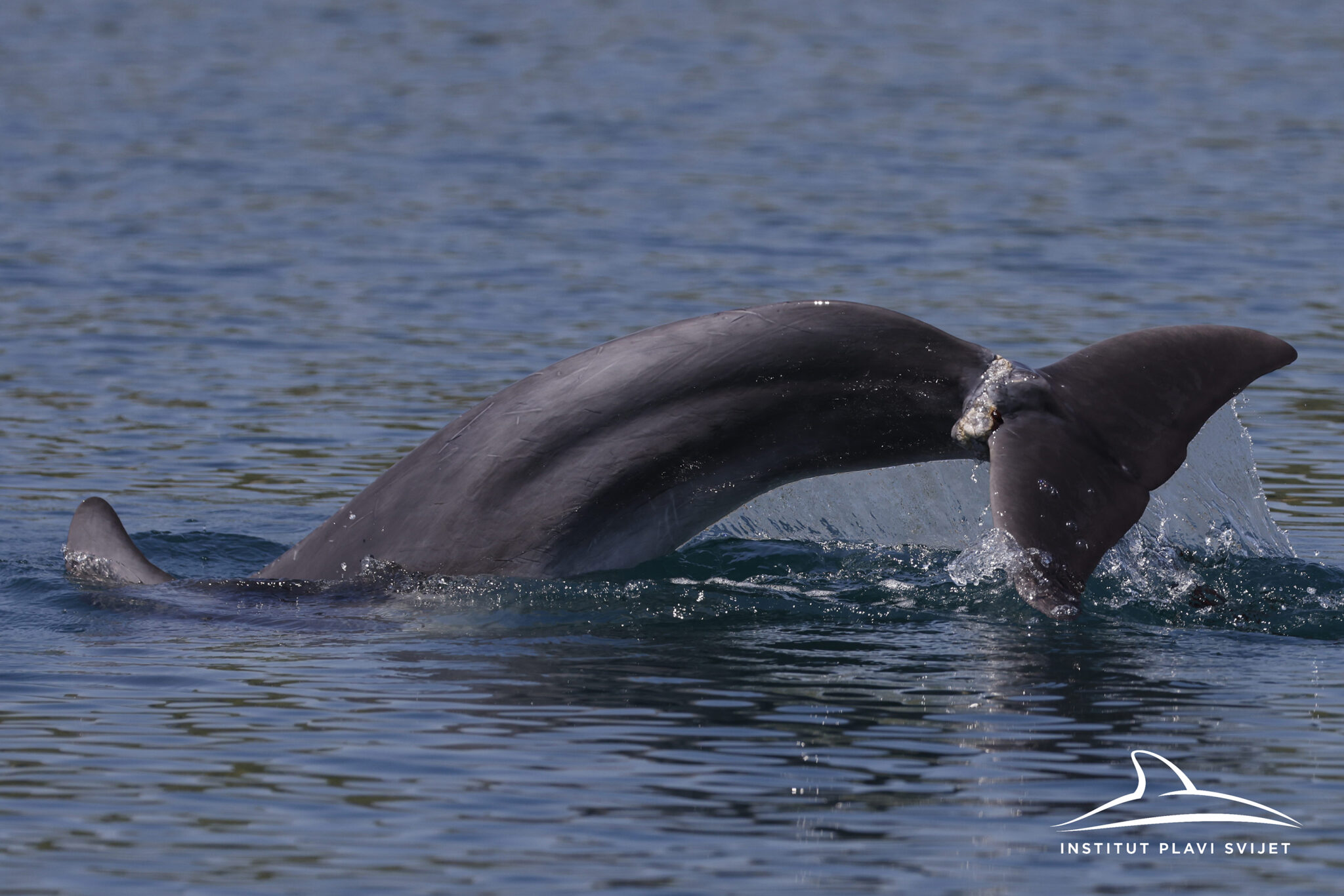
Bottlenose Dolphin in the Novigrad Sea with Rope Entangled Around Its Tail
Over the course of several hours, we repeatedly attempted to approach the dolphin in order to remove the remaining section of rope. Unfortunately, the animal would not allow us to get close, either by boat or in the water. Given that the bottlenose dolphin is in good physical condition and, despite the rope and the injury near its tail, is still able to move, hunt and feed effectively, we decided to discontinue further unsuccessful rescue attempts. This decision was made with the safety and welfare of both the dolphin and the researchers in mind. In the coming period, it will be necessary to continue monitoring this individual closely to ensure that an appropriate response can be undertaken should its condition change. We would also like to note that researchers from the Blue World Institute have received specialised training in the rescue of dolphins and whales entangled in fishing gear as part of the LIFE Delfi project. They also have access to specialised rescue equipment acquired through the LIFE Delfi project and the project Enhancing and Expanding the Capacity of the Lošinj Sea Turtle Rehabilitation Centre.
In general, dolphins in this condition are exposed to increased levels of stress, a higher risk of infection, and a greater likelihood of collisions with vessels. Their ability to swim and dive is impaired, and their capacity to feed is often reduced, which can ultimately lead to starvation.
In such circumstances, dolphins frequently move into more sheltered and shallower areas, where they become isolated because they are unable to keep up with other individuals or participate in normal social interactions. As a result, they are also more vulnerable to disturbance and, in many cases, harassment by people who encounter them.The likelihood of survival depends on several factors, including the animal’s physical condition prior to entanglement, its age, its ability to free itself independently or with the assistance of a rescue team, and the length of time it has remained entangled. It is also important to note that successfully freeing an animal from fishing gear does not guarantee its survival. Following disentanglement, continued monitoring is essential to assess its recovery and long-term prospects.
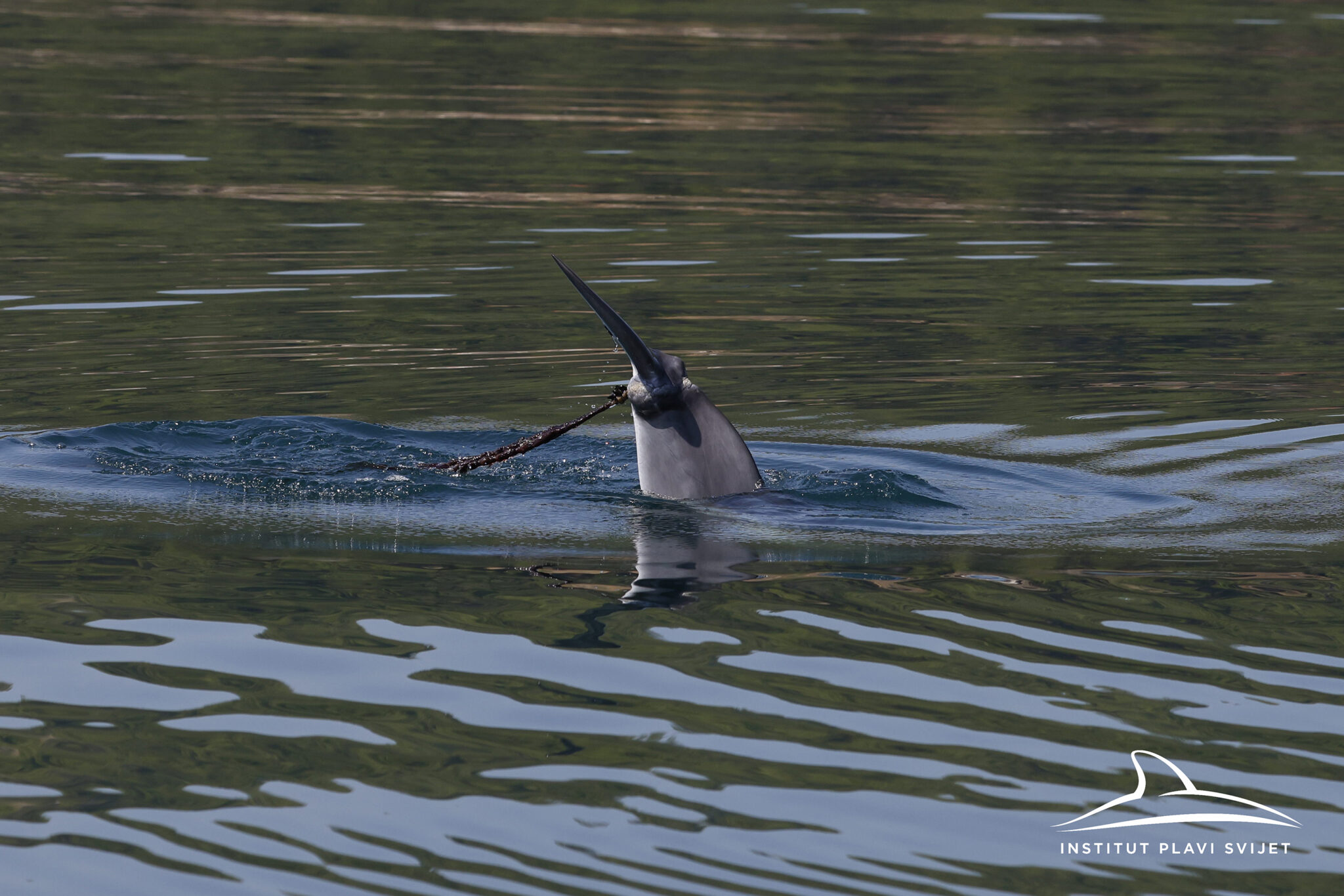
Bottlenose Dolphin in the Novigrad Sea with Rope Entangled Around Its Tail
The Blue World Institute will continue to monitor this bottlenose dolphin in the Novigrad Sea. To give the animal the best possible chance of survival, we kindly ask the public not to approach the dolphin, attempt to swim or dive with it, touch it, or feed it. As bottlenose dolphins are a strictly protected species, we also stress that no attempts should be made to remove the rope without consulting appropriately trained and experienced personnel. We encourage anyone who observes this dolphin, or any other dolphin, whale or Mediterranean monk seal, to send us information, photographs or video recordings by email at info@blue-world.org, by telephone on +385 51 604 666, or via the free Marine Ranger mobile application for Android and iOS devices (www.marine-ranger.org). In addition to allowing users to report sightings of dolphins and other marine wildlife in the Adriatic Sea, the application provides information about Mediterranean species and offers quick access to the nearest emergency service in situations where immediate assistance may be required.
Further updates and information will be published on our website (www.blue-world.org) and our Facebook page (http://www.facebook.com/blueworldinstitute).
Thank you for your support and cooperation.
We are proud that the Blue World Institute has received...
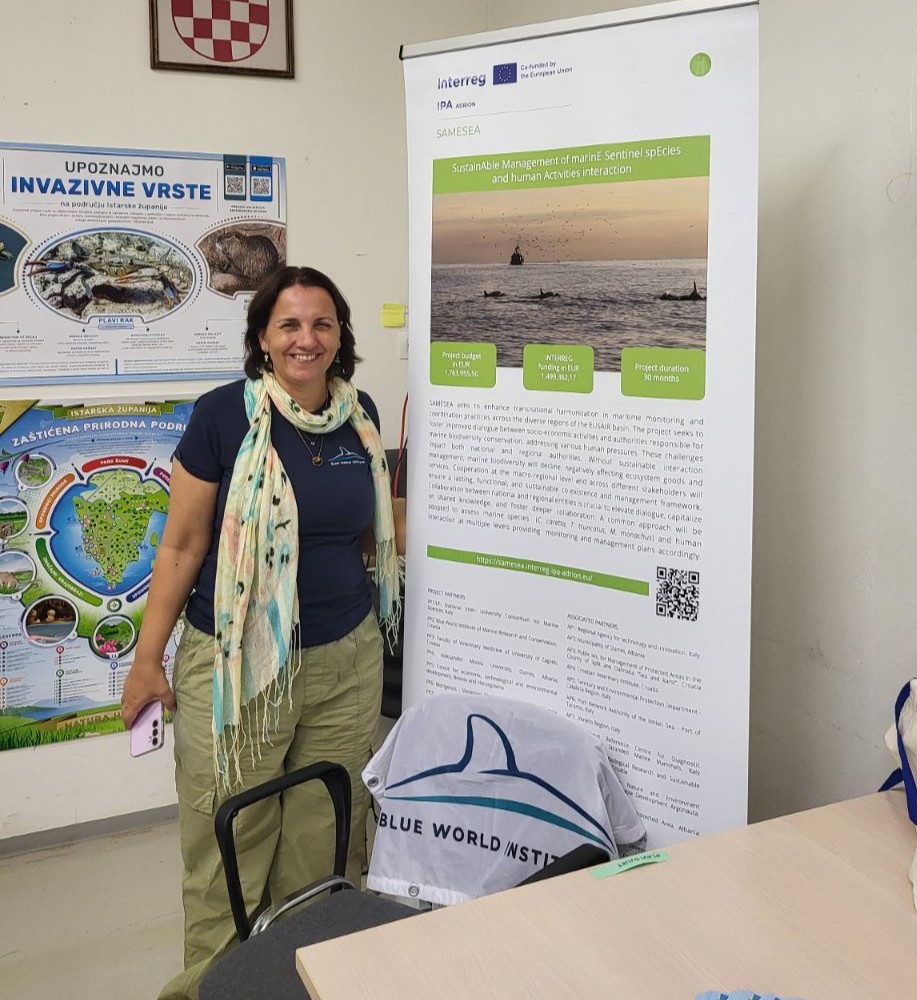
Last week, the members of the Blue World Institute participated...
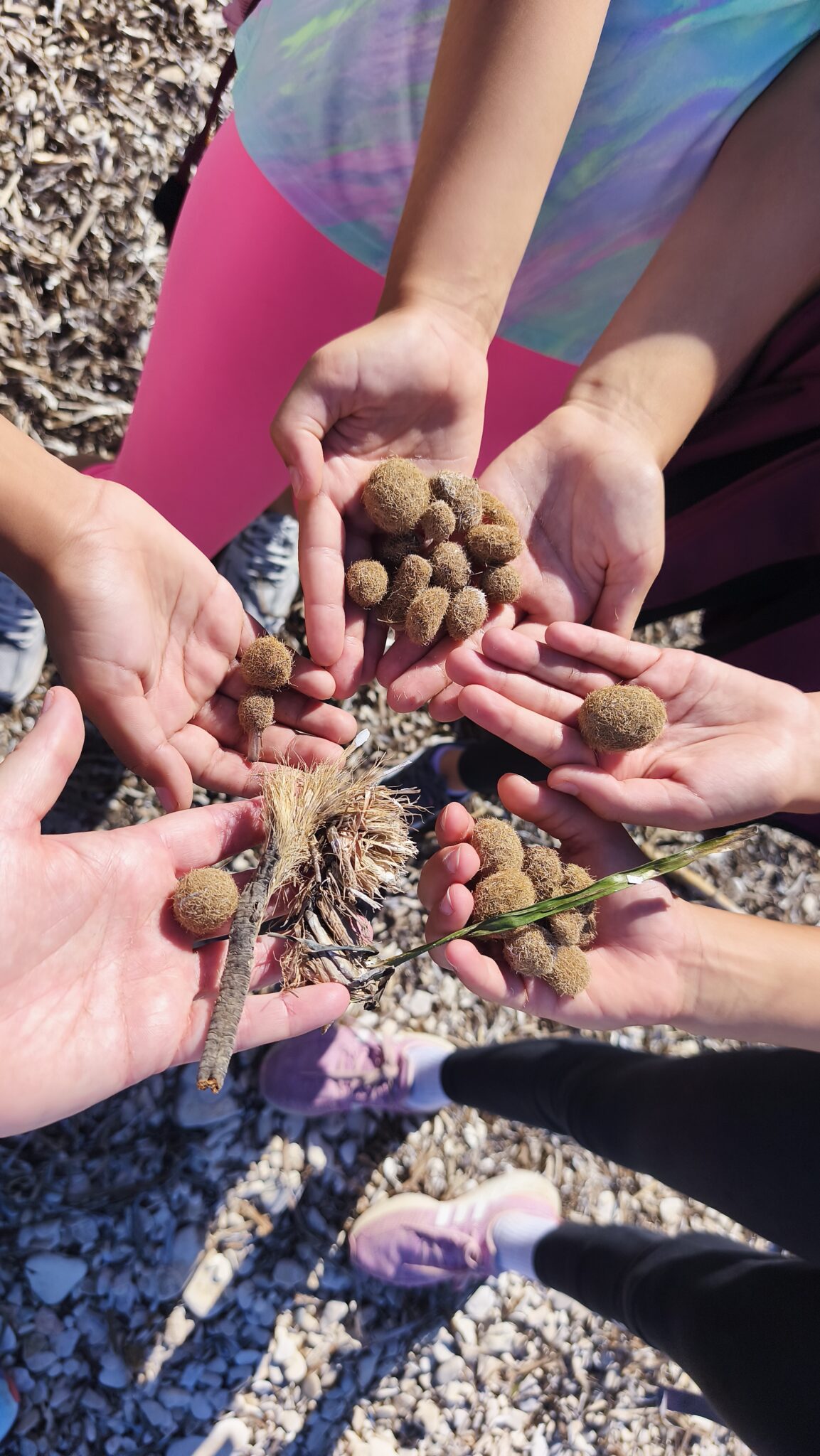
Yesterday, together with 4th-grade pupils from Mario Martinolić Primary School,...
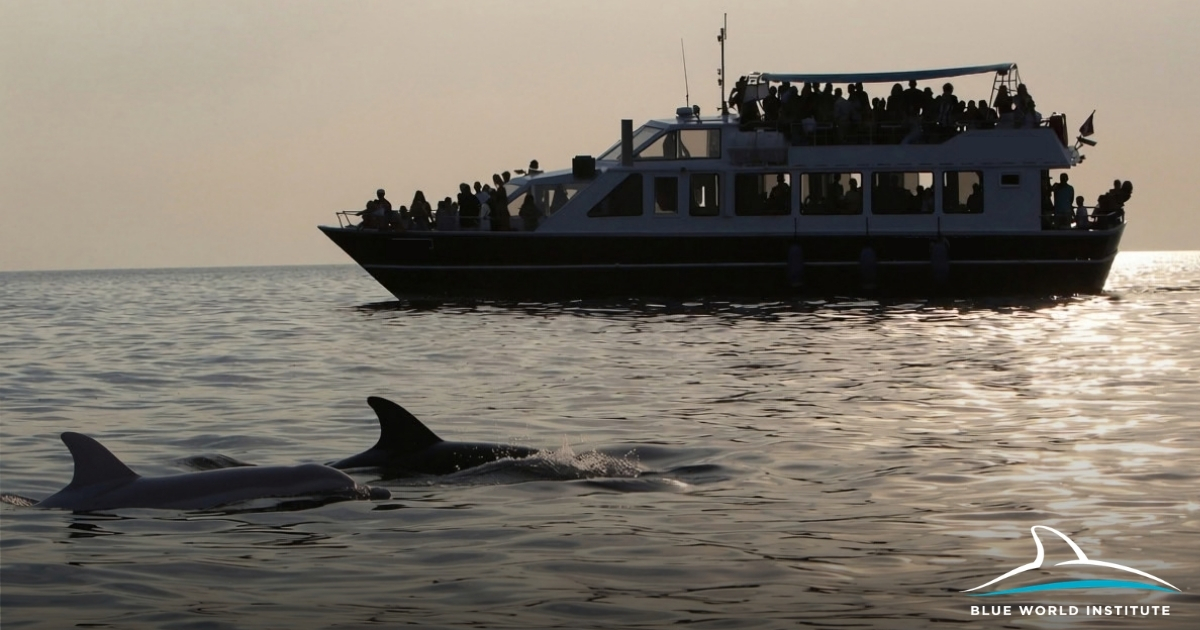
Dolphin observations have become an increasingly popular part of the...
